Photo cleanup guide
How to compress photos on iPhone (and when deleting frees more space)
Learn how to compress photos on iPhone, when Apple offers smaller copies, and when deleting clutter frees more storage than true compression.
By Pikondo team · Updated October 13, 2026
People search how to compress photos on iPhone when storage is full. True compression means making files smaller. Often the faster win is deleting clutter you do not need—screenshots, duplicates, and blurry shots—then using Apple’s tools when you still need a smaller copy to share.
Compression vs deleting clutter
Compressing a photo reduces file size. Deleting removes the photo (after Recently Deleted clears). Both can free space, but they solve different problems.
If your library is full of screenshots, near-duplicates, and blurry misses, cleanup usually frees more space than squeezing keepers. If you need to email or send a photo, a smaller copy is the right tool.
Share a smaller copy when you need to send a photo
- Open the photo in the Photos app and tap Share.
- Choose Messages, Mail, or another app that lets you pick image size.
- When prompted, pick a smaller size (Small, Medium, or Large) instead of Actual Size.
- Send that copy. Your original stays in Photos at full quality.
HEIC, JPEG, and what Apple already does
Most modern iPhones save photos as HEIC by default. HEIC is already more efficient than older JPEG for the same quality, so you are not starting from huge uncompressed files.
You can switch Camera settings to Most Compatible (JPEG) if you need broader sharing. That does not magically shrink your whole library. It changes how new shots are saved. Converting formats is not the same as a bulk “compress everything” button—and Apple does not offer one for the entire Camera Roll.
Storage settings that sound like compression
iCloud Photos Optimize iPhone Storage keeps smaller versions on the device and full-resolution copies in iCloud when space is tight. That can help local storage, but it is not the same as permanently compressing every file on your phone.
Treat Optimize as a space trade-off with iCloud, not a one-tap compress tool. Review what you keep before you rely on it alone.
When deleting frees more space than compressing
A short cleanup pass often beats hunting for a compressor. Screenshots, similar burst shots, and blurry misses add up fast and are easy to decide on.
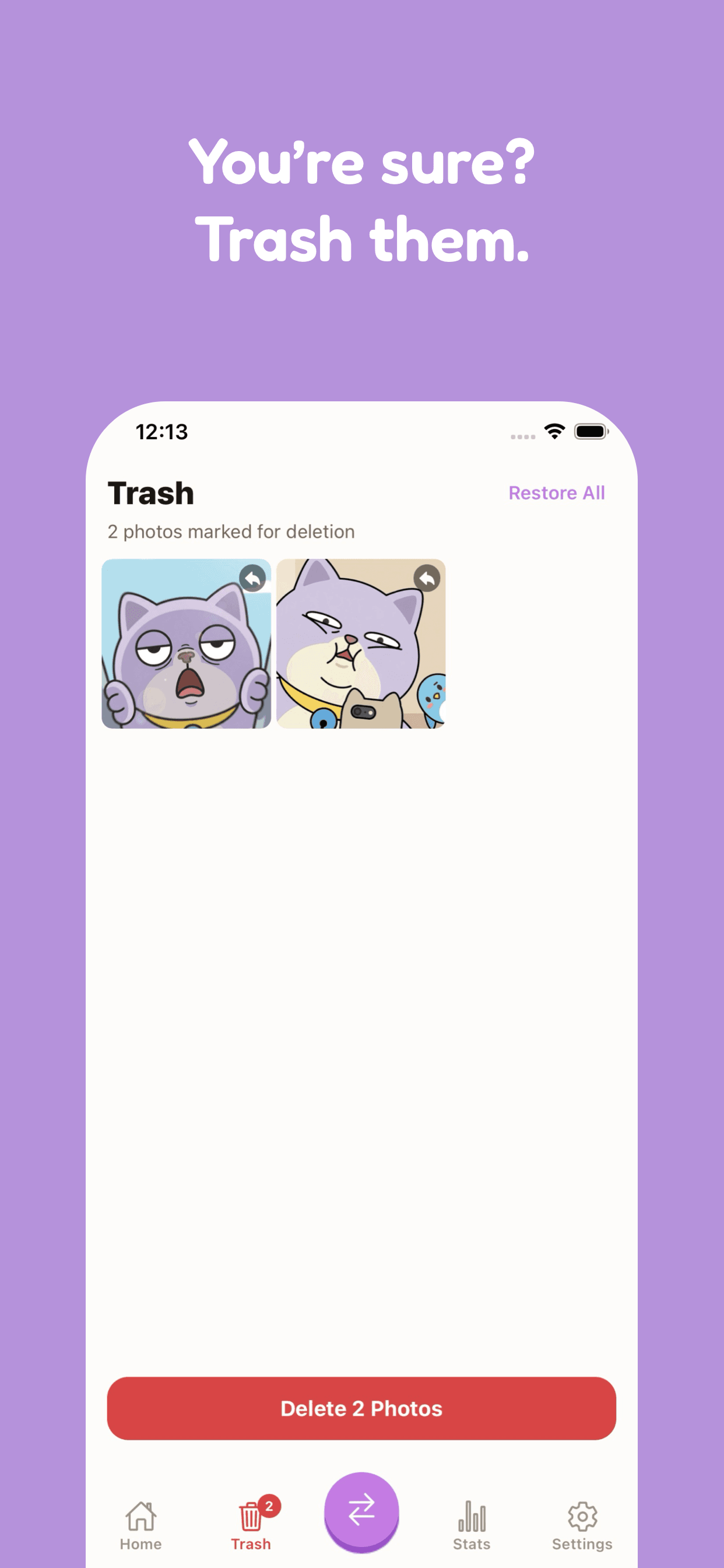
Pikondo helps with that review. Swipe to keep or mark for deletion, check your choices, then confirm. Your library stays on your device during review. Pikondo does not compress HEIC or JPEG files, and it does not convert formats. It helps you remove what you do not need so keepers have room.
Related guides
For storage and cleanup next to compression questions, see optimizing iPhone Storage at /blog/optimize-iphone-storage, turning off Live Photos on iPhone at /blog/turn-off-live-photos-iphone, deleting photos at /blog/how-to-delete-photos-iphone, freeing iPhone storage at /blog/free-up-iphone-storage, deleting duplicates at /blog/delete-duplicate-photos-iphone, clearing screenshots at /blog/delete-iphone-screenshots, removing blurry shots at /blog/delete-blurry-photos-iphone, recovering from Recently Deleted at /blog/recover-deleted-photos-iphone, hiding photos (privacy, not storage) at /blog/hide-photos-iphone, organizing keepers at /blog/organize-photos-iphone, converting HEIC to JPG at /blog/convert-heic-to-jpg-iphone, and freeing iCloud storage at /blog/free-up-icloud-storage.
The key point
To compress photos on iPhone for sharing, send a smaller copy from Share. To free space, delete clutter you do not need—and check Recently Deleted before anything is gone for good. Compression and cleanup are different tools; pick the one that matches your goal.
Frequently asked questions
- How do I compress photos on iPhone?
- There is no built-in “compress my whole library” button. To send a smaller file, use Share and pick a reduced size when the app offers it. To free storage, delete screenshots, duplicates, and blurry shots you do not need, then empty or review Recently Deleted when you are sure.
- Does Optimize iPhone Storage compress my photos?
- Optimize iPhone Storage can keep smaller versions on the device while full-resolution copies stay in iCloud. That helps local space when iCloud Photos is on. It is not the same as permanently compressing every original on the phone.
- Is HEIC already compressed?
- HEIC is an efficient format Apple uses by default on modern iPhones. It usually takes less space than an equivalent JPEG. Switching to JPEG for compatibility does not shrink your existing library by itself.
- Does Pikondo compress HEIC or JPEG files?
- No. Pikondo helps you review and delete clutter—screenshots, similar photos, and blurry shots—so you can free storage. It does not compress photos or convert formats. Use Share for smaller copies when you need to send a photo.